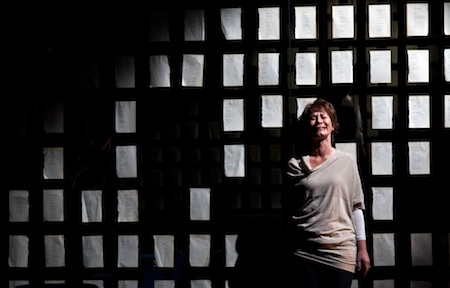
Happy Days/Care Instructions
My reviews of Happy Days and Care Instructions, which both opened last week at the Malthouse, are respectively in Friday's and today's Australian. More to follow here later this week. I hope.
Read More.....My reviews of Happy Days and Care Instructions, which both opened last week at the Malthouse, are respectively in Friday's and today's Australian. More to follow here later this week. I hope.
Read More.....
Posted by
Alison Croggon
at
2:30 PM Full post
0
comments
DiggIt! |
Del.icio.us
Labels: australian
I briefly reviewed Julian Meyrick's MTC production of The Birthday Party just over two weeks ago and have been meaning to write about it at more leisure ever since. That I haven't yet done so is symptomatic of (a) the time of year - it's flu season here in Williamstown, and various microbes have been doing a serial dance through the family home - and (b) the difficulty I'm having balancing the conflicting demands of my increasingly chaotic life. So this is a brief cathartic visit to some thoughts that have been irritating the delicate membranes of my synapses over the past fortnight.
Another reason for the delay was that I wanted to watch the 1968 William Friedkin film of The Birthday Party. Thanks to the magic of Amazon, it arrived last week. The screenplay was adapted by Pinter himself, and it features a great cast, with Robert Shaw in the central role of Stanley, Patrick Magee and Sydney Tafler as the mysterious strangers McCann and Goldberg, Dandy Nichols as the naive landlady Meg and Moultriie Kelsall as her husband, Petey. It's very much a film of its time - some of its special effects are worthy of YouTube - and it's obviously made with a budget of around $2. But it remains an astounding film.
It's not, by any means, comfortable family viewing. You watch it all the way through with your stomach in a knot, unease growing with the slow inevitability of nightmare as the play's banal but obscurely threatening situations unfold. What these performances do so beautifully is to demonstrate the startling dislocations of Pinter's dialogue, how he violently wrenches language from its emotional subtext. The story of the film is not in what is said, but what is going on in the actors' faces: the fear in Nichols' face as Shaw suddenly turns on her, asking if she knows who he is; Shaw's seemingly irrational terror when the two men appear in the miserable boarding house where he has been living for the past year; Magee's hesitation and fear in the face of Tafler's smoothly civilised violence.
It's not the notorious Pinteresque Pause that matters here; it's what going on underneath the language, which may indeed flower into silence, but equally occurs in the estrangement of the dialogue. The fact that Pinter's name is practically synonymous with the Pause has always faintly baffled me: other playwrights (and not only Beckett) have used pauses, which act as the writerly equivalent of musical notation, an indicator of linguistic and emotional rhythm. So why should Pinter's be so controversial? But those who wish to belittle his achievement for whatever reason - political disagreement, artistic hostility - always refer to the Pause, which is I guess a way of eliding the fact that he actually wrote a lot of words in between his silences.
It strikes me that this discomfort with Pinter's pauses reflects a wider cultural response to silence. We don't know what to do with it: we have to fill it up with noise, as if silence is a yawning abyss that threatens to devour our souls. I've noticed this especially when watching anime: the master of the medium, Hayoa Miyazake, uses silence beautifully in his carefully constructed soundtracks. But if in error I put on the dubbed versions instead of the subtitled Japanese soundtrack, suddenly all that fertile, evocative silence disappears under a welter of music and dialogue.
And it also reflects a cultural discomfort with, well, discomfort itself. Have we such a terrible fear of ourselves, of what might emerge if we are forced to contemplate the realities that underlie the camouflaging gabble of language, that we literally can't face it?
Which brings me to Julian Meyrick's production, now running at the Fairfax Studio in the Arts Centre. I think this is a perfectly respectable and intelligent production of the play, which in many ways brings a contemporary vitality to The Birthday Party. Meyrick has cast it mainly with Indigenous actors, in a rare and welcome example of main stage cross-racial casting. Smartly, he has avoided obvious racial power relationships: power and disempowerment reside in every character. The single white actor is Marshall Napier, a man of slippery identity, who is the locus of hidden but palpable violence. Goldberg's Irish sidekick McCann is played by Glenn Shea, his Irish song replaced by an Aboriginal chant. (This subtly draws an interesting parallel between the colonisation of Ireland and Australia). And I was particularly taken by Pauline Whyman's beautiful portrayal of Meg, the naif whose fantasy world almost completely protects her from the sharp edges of reality.
But - and for me it is a large but - there was something missing in the middle of the play. It was characterised by Isaac Drandic's performance of Stanley, which I am guessing, having never seen Drandic in action before, was a directorial decision. And perhaps - not having seen it again, I don't know - this performance has evolved from opening night. On the night I saw it, Drandic was a blank: he responded catatonically, with none of the repressed violence so characteristic of Shaw's performance in the film. This gives the performance nowhere to go, since in the final scene he really is catatonic; because he has been emotionally blank from the beginning, his inability to speak is much less devastating. And it neutralises many of the exchanges in the play, as Stanley is always a passive victim.
This sense of soft-focus permeates the tone of the whole production: the squalor of the boarding house, physically palpable in the details of Friedkin's film, is here rendered with a respectable cleanliness. There are moments of sudden brutality, moments of discomfort, but instead of winding slowly up to a kind of stomach-twisting panic, they dissipate in comic relief. It's too easy in this production to read The Birthday Party as a kind of surreal comedy about "those" kinds of people - lower middle class, Not Like Us - because its real power, its merciless exposure of the dark animal impulses in human behaviour, is muffled. The sense of interior nightmare never takes hold where it counts, in the primitive caverns of the subconscious.
The performances and direction bring out the absurd comedy of Pinter's language, which is in itself no bad thing. Like Beckett, Pinter is full of comedy: also like Beckett, he is also deadly serious, and laughter is only sometimes on the menu. Discovering that a playwright is funny shouldn't, as regularly happens with Chekhov, elide the tragedy that drives the drama. As I watched it, I thought of Howard Barker's stern comments about laughter in the theatre. "Laughter appears to be a manifestation of solidarity," he says, "but it is now more often the sign of subordination. It is pain that an audience needs to experience, and not contempt. We have a theatre of contempt masquerading as comedy".
I think Australian theatre is not arrogant enough to generate the contempt Barker speaks of. Rather, the impulse towards comedy reflects a different kind of subordination. It seems to me to be a fear of the audience, a fear that they will not get it, a fear that if they do, they won't like it anyway. Who, after all, wants pain? And in this fear we lose the larger possibilities of art, its paradoxical exhilaration and joy.
There is, alas, good reason for these fears, as the conversation after my review of The Man from Mukinupin - probably the MTC production I've enjoyed most this year - demonstrates all too clearly. And certainly, the production of The Birthday Party has been warmly received; indeed, it's been welcomed almost with relief, as if a visit to the dentist defied expectations by serving up chocolates instead. But I can't help pondering the value of presenting Pinter in a prophylactic, with all the danger at a comfortable remove. On the one hand, yes, there's more chance of attracting an audience to the work of a playwright generally considered "difficult". But on the other, what is the point, really?
Note: for more discussion of the play, you can find an earlier TN review of a production of The Birthday Party here.
Picture: (from left) Jada Alberts, Marshall Napier and Isaac Drandic in the MTC's production of The Birthday Party.
Posted by
Alison Croggon
at
10:25 AM Full post
3
comments
DiggIt! |
Del.icio.us
Labels: harold pinter, julian meyrick, mt
The nominations for the Helpmann Awards, our national awards for the performing arts (yes, I know it's problematic), were announced earlier this week. I read them with lively interest: I was part of this year's theatre panel, and the secret ballot meant that I had as little idea as anyone what the results would be. And they're quite interesting.
In the theatre category, Benedict Andrews' brilliant production of War of the Roses for the STC Actors Company is the dominant note, with a swag of 10 nominations in practically every category. And it's good to see that Food Court by Geelong company Back to Back, which was probably my highlight of last year's Melbourne Festival, has gained some well-deserved notice, with three nominations in the Industry category. Barrie Kosky's production of The Women of Troy, an STC production seen here at the Malthouse, also won three nominations in the theatre category. And - to my surprise and delight - so did Peter Evans's production of David Harrower's Blackbird for the MTC. I'm pleased to see this subtle, modest and passionate production, low on spectacle but high on sheer class, put next to the more obviously significant works.
The full list of nominations can be trawled here. The winners will be announced in Sydney on July 27.
Posted by
Alison Croggon
at
1:10 PM Full post
12
comments
DiggIt! |
Del.icio.us
Labels: helpmann awards
Well, I'm dug back into my burrow after a fortnight out of the office. I've been doing some in-depth theatrical investigation of a story by one of my favourite pin-up boys, Anton Chekhov. It's been a chance, rare in my life, to concentrate on one thing for a whole two weeks. Well, almost one thing: I did see a few shows, and still want to think a little further on the MTC's production of Pinter's The Birthday Party.
But stepping aside from the quotidian pressure for a little while has been a much-needed opportunity to touch base, and to reflect on the things I value, in life as much as in art. They're the same things I've always valued, but to articulate them is difficult; perhaps this constant unfolding and evolution, this desire to express what it is that delights and hurts us, is the entire practice of a life. Anyway, while I've been pondering the meaning of existence, work has been piling up on my desk: piles of envelopes and a few hundred emails in my inbox, reminding me of a bunch of things that have gone under the TN radar lately. I'm slowly catching up, which seems to be the refrain of my days.
Among several interesting events and shows, I missed the launch of the Store Room Theatre's 2009 season. Relaunching after a hiatus of public performance, artistic director Todd MacDonald has put together an ambitious program that looks rich, various and deeply interesting. It's a staggeringly diverse program that includes new work by Ming Zhu-Hii, Ross Mueller, Tommy Murphy, Cerise de Gelder and Lee Blessing. One work, designer Anna Tregloan's The Dictionary of Imaginary Places, is part of the Melbourne Festival program. (Tregloan's last piece at the Malthouse, an installation/theatre piece called Black, was a fascinating immersive experience.) Which reminds me that we're coming up to the Melbourne Festival's official launch next week, and I'm working on a thorough preview of Brett Sheehy's first program. Watch this space.
Posted by
Alison Croggon
at
10:37 AM Full post
4
comments
DiggIt! |
Del.icio.us
Labels: blog biz, store room
My review of Jersey Boys is in today's Australian.
Read More.....
Posted by
Alison Croggon
at
10:57 AM Full post
13
comments
DiggIt! |
Del.icio.us
Labels: musicals
I see the chairman of News Ltd, John Hartigan, has some harsh words for bloggers. In an address to the National Press Club yesterday, he claimed that "amateur journalism trivialises and corrupts serious debate", and that only well-trained professional journalists wrote reliable news. (This, I am sure, has nothing whatsoever to do with News Ltd's launch of its blog-style commentary website The Punch, "Australia's best conversation"). As he is further reported in the Age:
"In return for [bloggers'] free content, we pretty much get what we've paid for - something of such limited intellectual value as to be barely discernible from massive ignorance," he said. "Like (Paul) Keating's famous 'all tip and no iceberg', it could be said that the blogosphere is all eyeballs and no insight." He said blogs often gave a platform for "radical sweeping statements unsubstantiated with evidence".
Mr Hartigan has a point, but as always in these debates, he's comparing the worst of blogging with the best of journalism. If you reverse the comparison, and compare the worst of journalism with the best of blogging, you can come up with a completely different picture. For example: if professional reporters are such glowing avatars of responsible fact-checked journalism, how come the hoax story of Jeff Goldblum's death got flashed around Australia on Monday, hmmm? I read it on the Age's website...
And everyone who has been interviewed for the mass media knows the perils of misquotation. I was once interviewed by a print journalist with no visible notebook, who then drew a series of wholly moronic quotations from her less-than-vivid imagination. I mean, I'm happy to stand by my own stupidities, but it tries your patience to be made to look more idiotic than you actually are.
As in so many parts of my life, I have a foot in both camps. I'm a blogger who got an old-fashioned and thorough training in print journalism back when dinosaurs roamed Flinders St. In those days, the line between journalism and fiction was sometimes very thin indeed: I once, with these very eyes, watched a weather-beaten hardened cynic of a journalist completely make up a rattling story for the front page of a (now defunct) newspaper, after an afternoon of fruitless phone calls turned up no confirmation whatsoever of a headline-grabbing rumour. But even that seems preferable to the routine processing of press releases that constitutes so much contemporary reporting these days.
So, sure. If traditional newspapers produce fine journalism, I'm all for them. Sometimes they do. But you can be sure that very often the very structures of news gathering mitigate against such things. I'm totally with Mr Hartigan when he says that "amateur journalism" trivialises and corrupts serious debate: but his argument would have more strength if it didn't so often grace the mainstream media. Maybe a case of taking the beam out of his own eye first?
Posted by
Alison Croggon
at
7:58 AM Full post
15
comments
DiggIt! |
Del.icio.us
Labels: media
I just woke up to the sad news that Pina Bausch has died at 68. Her tours of Australia had an electrifying influence on Australian theatre and dance, among many others inspiring Meryl Tankard (whose latest work is on at Malthouse at the end of the year). George Hunka has a memoriam here.
Update: David Jays recalls his first encounter with the work of Pina Bausch.
On a brighter note, it's encouraging to see that Lyndon Terracini has been appointed as the new artistic director of Opera Australia, which has had a troubled time of late. He's been welcomed warmly as an "inspired" choice for the position, and has announced his intention to nurture young composers and new Australian work. He has form on this that stretches back long before his artistic directorship of the Queensland Music Festival. Back in the 90s, he was in fact responsible for my first ventures onto the stage: Terracini was the force behind two operas by Michael Smetanin for which I wrote the libretti, The Burrow and Gauguin, and sang the lead roles. So now you know who to blame.
Posted by
Alison Croggon
at
8:06 AM Full post
6
comments
DiggIt! |
Del.icio.us
Labels: pina bausch
My review of the MTC production of Harold Pinter's The Birthday Party was in yesterday's Australian. Lots more to think about, and I hope I get a chance to do so (time is in short supply in Ms TN's world): on the one hand, how liberating to see these excellent Indigenous actors on the MTC stage; on the other, how disappointing that their talents are not fully exploited. It's an intelligent production that soft-pedals the underlying violence and terror of the play. I see that Captain's B'log has no such reservations: but he has uploaded a clip from the original film, which shows how absurdity and menace can run together in the same breath. My god, that Patrick Magee was something, eh?
Read More.....
Posted by
Alison Croggon
at
11:52 AM Full post
0
comments
DiggIt! |
Del.icio.us
Labels: australian, harold pinter, mtc
Dorothy Hewett would have been amused. Last Tuesday, Ms TN high-tailed it to the Sumner Theatre to see The Man from Mukinupin. I turned up to what I thought was the pre-show scrum, wondered why no-one was checking tickets at the theatre door (how odd, I thought, and shrugged, dismissing the thought), and sat down to enjoy the show. Which I did.
On my way out, still vibrating with Hewett's lyrical passion, I bumped into a well-known Melbourne poet. What did you think? I asked. Oh, he said, it's Hewett attempting to write a Shakespearean comedy, and, well, frankly, it's a bit of a mess... At which point, my mind became a series of exclamation marks. How, I wondered, could you see that play and think first of all about messiness? And a familiar cloud that I associate with the world of poetry, which so often seems like a tea party of Victorian ladies carefully arranging the doilies of reputation, rose like a dank miasma in my brain.
But there were a couple of alarm-bells. The program said the show went for two and a half hours, with a 20 minute interval: but we were clapping the actors after 90 minutes. How strange, I thought, they don't usually make that mistake on a program: and off I went home, beset by vague worry. Over the next couple of days I hunted unsuccessfully for my copy of the play, which along with a whole bunch of other feral books, seems to have vanished into the dimmer recesses of L-space. Finally abandoning the quest, I rang the MTC's PR staff to check the discrepancies.
You will, of course, be way ahead of me. I had turned up at interval, not realising that Tuesday shows start at an hour and a half earlier than usual, and I had happily watched half a play, thinking it was the entire show. Perhaps, thought a chastened Ms TN, I had been mistaken in so hastily condemning the doily-ideology of the poet: perhaps the play really was a shambles. So this Tuesday, neurotically checking my watch, I once again wended my way to the MTC, and saw all of the play.
Is it a mess? Perhaps. I'm not so sure this matters very much. Such cavils remind me of John Dryden's discussion of "dramatic poesy". (Dryden was the first Poet Laureate, and in his day a shining light of the Restoration stage, newly emerged after a long hiatus in English drama caused by the closing of the theatres.) While allowing that Shakespeare was paramount for his vital portrayal of Nature, being superior in his imaginings to the nancy classicism of the French, Dryden concludes his discussion by suggesting that verse is "a rule and a line by which [the poet] keeps his building compact and even, which otherwise lawless imagination would raise either irregularly or loosely".
Order and regularity - if perhaps trumped by the radiant sun of Shakespearean "genius" which is, fortunately, very rare (and he was already a dead poet) - was all. To this end, Dryden rewrote several of his forebears, including an operatic adaptation in rhyming couplets of Milton's Paradise Lost, one of the greatest works of blank verse in English. Given Milton's famous attack on the "the jingling sound of like endings", rhyme being "a troublesome and modern bondage" that shackled the "ancient liberty" of poetry, it seems a foolhardy and impertinent exercise. Dryden's Miltonic adventures suggest that metrical propriety is is merely the outward clothing of an unpoetical moral obedience.
Dorothy Hewett would have given Dryden conniptions. She was lawless in her writing and her life, bowing to no rules. She wrote good verse if she chose to, and ignored it when she didn't; she acted with a fine inattention to propriety of any kind, but always with a passionate truthfulness. Worst of all, she was a woman. In the 17th century, an outspoken woman of letters was considered at best an absurdity and at worst an obscenity. Although things have certainly changed since then, the rags of those attitudes have a strange persistence in many literary circles.
Certainly The Man from Mukinupin demonstrates none of the tidy formality so admired by Dryden. It is a glorious patchwork of pastiche, merrily stitching Australian folksong, vaudeville and Elizabethan epithalamion to some wicked imitations of the more moralistic Victorian poets. It's structured as a classic comedy (everyone gets married in the end). But this is a comedy that talks about Aboriginal genocide, and that takes a satirical glance at the myth of nationhood forged through the blood sacrifice of World War 1, situating both in an evironment degraded by salination caused by farming. The erotic relationships of each of the couples are underlaid by a dark subtext of violence, self-destruction and despair.
In short, Hewett breaks every rule going, which is perhaps why she is often treated with suspicion (as she said, theatre critics always called her a "poet", and poetry critics always said she was a "playwright"). But she breaks the rules with irresistible elan. The patchwork becomes a whole thing because of the fusing force of her passion: passionate anger, passionate desire. And perhaps most importantly, by her direct, unembarrassed desire to make beauty.
For those unmoved by such passions, it's easy to find fault with the text: the first act is perhaps a little clumsy, and the second act (which on two viewings I decided was quite brilliant) features some contrived deux ex machina plotting. And so on. Certainly it's not neat, and perhaps the first act could have benefited from some cutting. But to me such suggestions are a little like saying that Blake ought to work more on his scansion: they miss the point. Quod scripsi scripsi and all that: chilly perfection was never Hewett's bag. And the fact is that the flaws are a little like the asymmetries and blemishes of a loved face: they are its living imperfections, the idiosyncrasies that make it unlike any other.
Wesley Enoch has given The Man from Mukinupin a vitally lucid production that is very much in the spirit of the writing. It subtly highlights the subtext of racism by casting Indigenous actors wearing whiteface, but otherwise lets the writing speak for itself.
Richard Roberts's set is beautiful. Much of the action takes place before a curtain of calico sheets, hung as if on a washing line, which he also uses for some great shadowplay. When the curtains are drawn back, it reveals an edgeless space behind it, a sand-floored, impressionistic picture of Mukinupin seen through the imagery of fringe-dwellers: a broken down caravan with cheap cotton curtains, a stone-edged campfire, the naked limbs of trees, moodily lit by Rachel Burke. The band, playing Alan Johns's arrangement of Jim Cotter's original music, are seen in half-light backstage, near a wooden counter that represents the General Store.
Enoch has directed it as music theatre rather than a musical, with an emphasis on theatricality that generates hugely enjoyable performances from his excellent cast. Suzannah Bayes-Morton, in the double role of Mukinupin belle Polly Perkins and her outcast half-white half sister Lily, perhaps has not the strongest of voices, but makes up for this by the impure poignancy of her singing. Her songs, backed by a wittily directed chorus, were highlights.
Many characters are twinned, with siblings acting as archetypal mirrors of the light and dark sides of Munikupin: the brothers Jack and Harry Tuesday, played by Craig Annis, or Eek and Zeek Perkins (Max Gillies). Others, like the damaged wife of Eek, Edie, are double-natured. Edie is possessed by an oracular spirit which speaks her crushed desires and hatreds, her amplified voice echoing through the theatre like a dark angel. But all of them - David Page, in three roles, Valentina Levkowicz as Clemmy Hummer, Melodie Reynolds as Clarry Hummer and Widow Tuesday, and Amanda Muggleton being fabulous as the melodramatic actress with an eye for the main chance, Mercy Montebello - deserve mention.
Although I was never bored, I was ready for the first act to finish when it did. But the second act - and as you know, I speak from dutifully repeated watching - runs like a river in flood. It's a wonderful play, here given a revival that respects it in all the right ways. It shows that in her political intuitions, Hewett was way before her time, and that stylistically she deserves to rank with Patrick White as a defining Australian playwright. Like White, she draws her theatre from vulgar traditions such as vaudeville as well as modernism, but her attack on vernacular speech has more sheerly joyous vigor, a knowing intimacy that White could not quite attain. And her anger and passion are still startlingly contemporary.
Picture: Suzannah Bayes-Morton as Lily Perkins in The Man from Mukinupin. Photo: Earl Carter
The Man from Mukinupin by Dorothy Hewett, directed by Wesley Enoch. Musical direction Alan John, set and costumes by Richard Roberts, lighting design by Rachel Burke, choreography by Jack Webster. With Craig Annis, Suzannah Bayes-Morton, Max Gillies, Valentina Levkowicz, Amanda Muggleton, David Page, Melodie Reynolds and Kerry Walker. Company B and Melbourne Theatre Company, Sumner Theatre, until July 19.
Posted by
Alison Croggon
at
5:38 PM Full post
28
comments
DiggIt! |
Del.icio.us
Labels: dorothy hewett, mtc, wesley enoch
My review of Circus Oz's fab new show, Barely Contained, was in Monday's Australian.
Read More.....
Posted by
Alison Croggon
at
8:36 AM Full post
2
comments
DiggIt! |
Del.icio.us
Labels: circus oz
This blog is kept by me, Alison Croggon, a writer who lives in Melbourne, Australia. I am presently Melbourne theatre reviewer for The Australian and irregularly review books for ABC Radio National's The Book Show. Between 1989 and 1992 I was Melbourne theatre reviewer for The Bulletin. In 2009, I was named Geraldine Pascall Critic of the Year for my work on this blog and in the Australian.
I write poetry and novels as well as criticism, and
have an abiding interest in theatre as both
practitioner and critic. I edit the literary webzine Masthead and am married to the playwright
Daniel Keene. Since 2007 I have been a panellist for the Green Room Awards and was a member of the
2005 and 2006 Artistic Counsel for the Malthouse Theatre. As a member of the Counsel, I offered criticism and feedback at the end of each season as part of the the theatre's process of self-assessment. From 1997 to 2002 I served on the board of the Keene/Taylor Theatre Project. I also contribute to the Australian group litblog Sarsaparilla. More information is available at my home page and the fantasy author me blogs at The Books of Pellinor.
Theatre Notes is sponsored by no one, apart from the usual provision of theatre tickets by theatre companies. In cases where there might be perceived to be a conflict of interest, aside from those mentioned above, I follow Robert Brustein's example and declare my interest at the bottom of the review.
My reasons for making this blog and the philosophies behind it are outlined in my first post in June 2004 and more recently here.
"Provocatively intelligent"
Lyn Gardner, The Guardian
"Want to find out about theatre in Australia? Try Theatre Notes."
Culture Vulture, The Guardian
"Impossible to fault, and hard to beat"
Gerard Windsor, Sydney Morning Herald
"astringent but precise and passionate perception, thy name is Croggon"
George Hunka, Superfluities
"Invigorating writing, thoughtful and extremely eloquent"
Encore Theatre Magazine
I always try to see as many shows as I can, but life (that thing that happens when you're making other
plans) limits my spare time. Please don't be discouraged if I don't make it; remember that I don't get paid for this; and keep in touch.
My email is ajcroggon at gmail dot com. Send me a note if you would like to be put on the mailing list for update alerts.
All writing on Theatre Notes, except that specifically attributed to guest authors, is copyright Alison Croggon 2004, 2005, 2006, 2007, 2008, 2009. 
Theatre Notes by Alison Croggon is licensed under a Creative Commons Attribution-Noncommercial-No Derivative Works 3.0 Unported License.